
Call/Text Us:
Email Us:
Normal Hrs: Mon-Fri: 7am – 7pm
- Emergency Hrs: 24/7

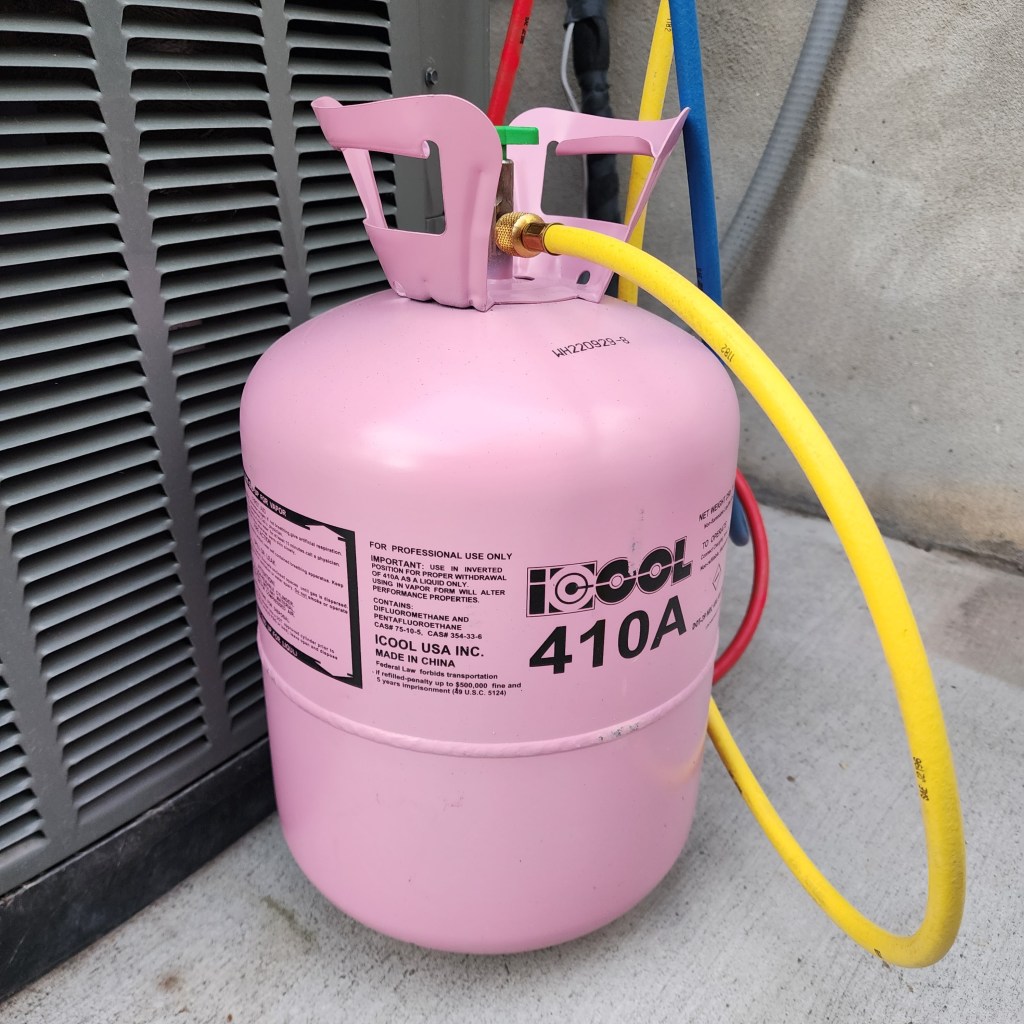
This isn’t the first time the air conditioning industry has changed refrigerants, and it definitely won’t be the last time too. The refrigerant that most people can remember and is the easiest to recall is R22. Most people just called it by it’s regular manufacturer product name, Freon.
R22 or Freon was used in almost all US air conditioners, residential and commercial versions between 1950 to 2010. Millions of R22 air conditioners are still being repaired, recharged an maintained to this day.
Freon or R22, is a refrigerant gas that works at low pressures 200-300 psi, is nonflammable, and if exposed to skin or metal it is nonreactive, nontoxic and noncorrosive. For decades it was the miracle coolant, the greatest refrigerant to ever be discover besides natural refrigerants like water and Ice.
But that all changed when it was discovered that HCFCs when released into the atmosphere will break down from sunlight UV exposure, releasing chlorine into the atmosphere. Radical Chlorine gas then bonds with Trioxygen O3, also know as Ozone, a naturally occurring UV absorbent gas that can soak up the sun’s high energy UV rays and naturally forms a section of our upper atmosphere referred to as the Ozone layer. R22, Freon or CHLORODIFLUOROMETHANE, the actual chemical name of Freon, is a HCFC ( hydrochlorofluorocarbon ) compound, and does exactly what was just described, it breaks down in sunlight, releases chlorine gas and eats away at the Earth’s ozone layer.
It was unhappily discovered in the 1970’s that all of the released HCFCs from aerosol propellants to air conditioning refrigerants had over the course of decades, broken down and developed a massive hole in earth’s Ozone layer. As a result of this discovery in 1987, a multinational joint effort treaty was drafted, adopted and signed to address and reverse the destruction of the ozone layer. The treaty was named the Montreal Protocol, since the treaty was held in Montreal Canada.
Did you love Big Hair spray, Ice Cold Freon and Air Conditioners that use to last 40 to 50 years? Remember to Thank Canada.
The EPA, (Environmental Protection Agency) an existing regulatory agency here in the United States founded in 1970, was tasked in 1990 through the Clean Air Act to directly address freon and come up with a solution to minimize R22’s negative environmental effects. Their solution was to follow the Montreal Protocol and gradually begin phasing out freon gas production and its equipment.
The phase out process began in 2003, production of R22 based equipment began lowering, and manufactured in its place was a new refrigerant that had been developed called Puron or R410a. In 2004 most R22 manufacturers finally switched to the new R410a refrigerant. In 2010 R22 based air conditioners were completely banned from production and sale in the US, along with most replacement parts like coils and compressors. In 2020 Freon gas production was completely eliminated, now only reclaimed and recycled R22 can now be used and sold here in the US.
Freon was a uniform, single compound refrigerant and was replaced with a blend of 2 different refrigerants to form 1 working refrigerant that could match the power and performance of R22. The two refrigerants that make up R410a, are R32 (difluoromethane) and R125 (pentafluoroethane), neither one contains chlorine, making R410a HFC (hydrofluorocarbon) Chemical compound.
The resulting 50/50 (R32/R125) Frankenstein gas mixture was dubbed Puron… or Forane, EcoFluor, AZ-20, Genetron, and Suva depending on where you live on the planet, no one could really pin down a name that rang out and could be as well remembered as Freon. And believe it or not, some did give up on calling it any of those and just started calling it “Fancy Freon”, a very nice ring to it, but in the cooling business every Tech out there has it memorized as 410A.
R410a was developed by the Honeywell manufacturing company in 1991 as a suitable replacement for R22.
When R410a was first developed, it was in the direct response of stopping the Ozone layer depletion. R410a has a 0% ozone depletion rate. It fit the bill and did it’s job, it provided reliable air conditioning without the atmosphere killing properties of R22 Freon. But it did has one side effect, when released into the atmosphere R410a doesn’t easily break down, it acts like a green house gas like carbon dioxide. To be clear, if CO2 Carbon Dioxide has a global warming potential (GWP) of 1 when released into the atmosphere, then R410a has a GWP of 1890. R410a has 189,000% more Green house gas warming ability than Carbon Dioxide. Sounds like we could send all the R410a on planet earth to Mars and warm it up by almost 200,000%, someone should tell NASA.
As you’ve probably guessed, R410 was targeted for Termination because of its ability to significantly warm the planet. The EPA administration here in the US has laid down phase out plans for the refrigerant.

There are actually two refrigerants that will replace R410a. R32 and R454B. R32 is currently in use in all 410a systems since half or 410a is R32. The other refrigerant, R454B is a blend of R32 (31.1%) and R1234yf (68.9%). We can clearly see R32 is in both new refrigerants. Both refrigerants are 5% more efficient when compared to R410a, and both have very low Global Warming Potentials.
Both refrigerants are reliable, safe and efficient, the only real difference is the price between r410a and A2L refrigerant based air conditioning systems. Manufacturers have been forced to retool their manufacturing equipment, and modify their assembly lines. New sensors are required to be installed on any existing furnaces built and installed before 2025 that will be used or combined with a new A2L based air conditioner. These sensors are required to detect leaking refrigerant to prevent a fire hazard and an unsafe operating condition.
As of right now the new air conditioners are set to cost any where from 20-30% more than current R410a based systems, prices should stabilize in the next coming years.
If you’re lucky enough to still have a freon based air conditioning system and it is low or out of refrigerant, it is still 100% legal to call an HVAC company and have them refill or top off your R22 Condenser. R22 is typically sold by the pound and is increasingly more expensive to buy since it can no longer be manufactured. Typical costs per pound of R22 can be anywhere between $250-400 dollars a pound not including labor. A full 25 pound bottle is now worth more than an ounce of gold.
There is a cheaper replacement refrigerant option for those older R22 systems if you don’t want to fill your air conditioner with silver and gold. A refrigerant called R422 can be used as a replacement substitute. The only downside is that it cannot be added or mixed with any R22 that is left in the AC system. A full evacuation on your air conditioner must be performed and all existing R22 removed before the system can be refilled with the R422 substitute refrigerant. Typical costs for R422 can be anywhere between $140-250 dollars per pound not including labor. R422 can restore any R22 based air conditioning or heat pump system 100% back to manufacturer intended operational efficiency and is EPA safe and compliant. R422 will never be banned and does not have a phase out date.
If your old Freon based air conditioner has an unpreparable leak or a broken or burnt out compressor, there is no way to get new replacement parts from the manufacturer, and they’re not allowed to sell them either. There are still fans, capacitors and electrical contactors to repair these aging systems just not the big guns. If your AC system has suffered a catastrophic failure your best option is to grab a tried and tested R410a Air Conditioning System or wait for a A2L based system that will appear just after January 2025.
 English
 Spanish